
Education
Why Bilingual AI Education Matters
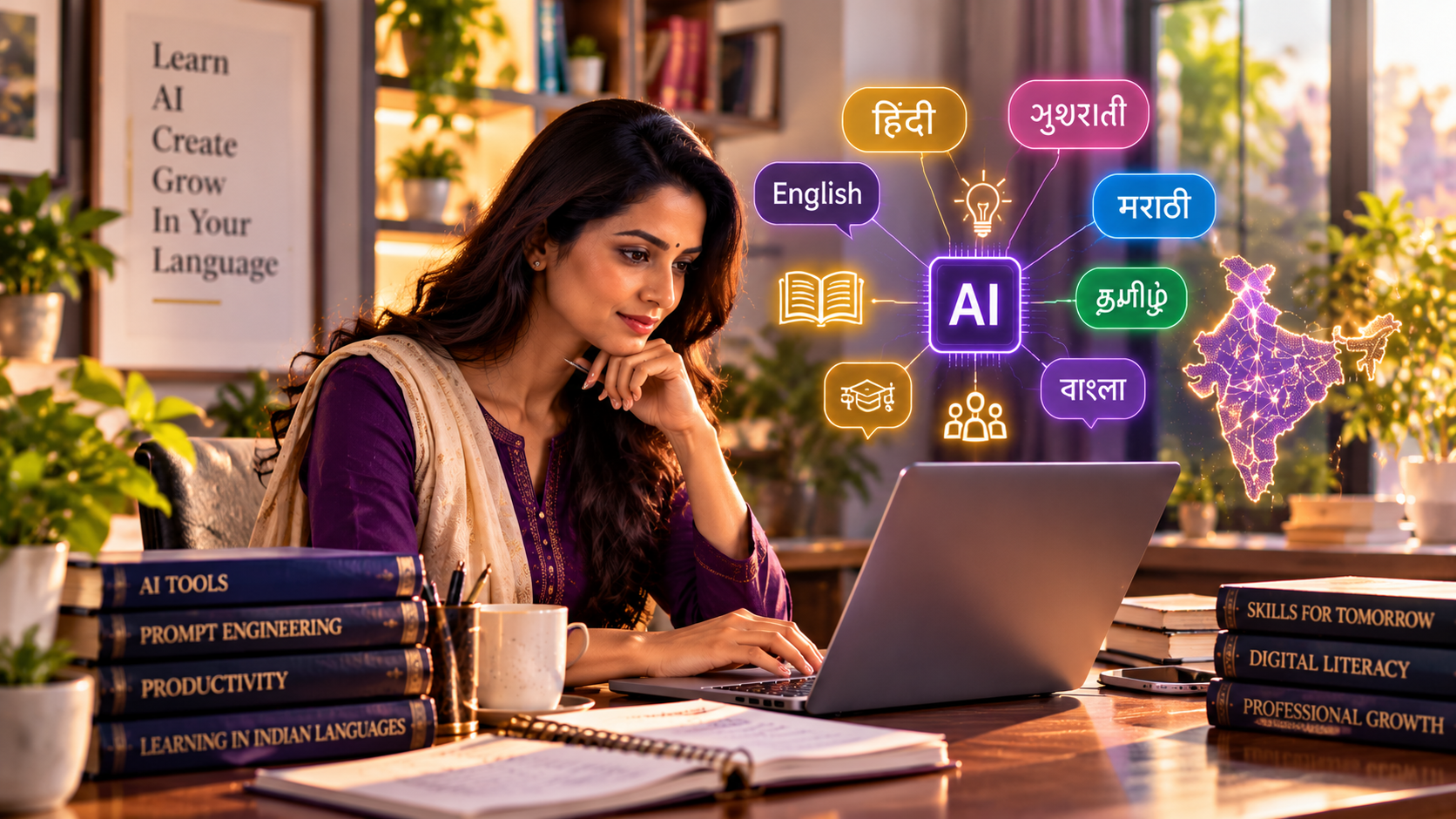
Artificial intelligence is becoming part of everyday professional life. Lawyers, educators, entrepreneurs, students and business professionals are using AI tools for research, writing, analysis, content creation and productivity.
But there is an important question that is often overlooked:
Can people fully benefit from AI if they are not comfortable learning about it in English?
For millions of people in India, language can influence how easily they understand a new technology, experiment with it and eventually make it part of their daily work.
AI Adoption Is Also a Language Question
Much of the information available about artificial intelligence is presented in technical English. Tutorials, documentation, prompts, online courses and discussions about AI frequently assume that the learner is comfortable with specialised terminology.
This can create an unnecessary barrier.
A person may understand their profession extremely well but still hesitate to use AI because the technology is being explained in a language that does not feel natural to them.
The problem is not a lack of intelligence or ability. It is often simply a lack of accessible learning.
Learning AI in a Familiar Language Changes the Experience
When a complex concept is explained in a person's preferred language, learning can become more intuitive.
Instead of first translating the explanation mentally and then trying to understand the technology, the learner can focus directly on the practical idea.
This becomes particularly important when teaching concepts such as:
- Writing effective prompts
- Using AI for research
- Summarising documents
- Creating content
- Automating repetitive tasks
- Understanding AI limitations
- Checking AI-generated information
These are practical skills. They should not become inaccessible simply because the terminology is usually presented in English.
Why This Matters for Indian Professionals
India is linguistically diverse. Professionals may be highly comfortable in English, but many people communicate, learn and think more naturally in regional languages.
Consider a lawyer who understands legal practice perfectly but is new to AI.
Explaining an AI workflow using familiar language and practical legal examples can make the concept much easier to understand. The same principle applies to a small-business owner learning automation, a teacher exploring AI tools or a student learning how to use generative AI responsibly.
The goal is not to replace English. The goal is to remove unnecessary language barriers.
Bilingual AI Education Can Build Confidence
Learning a new technology involves more than understanding instructions. It also requires confidence to experiment.
When people can ask questions and receive explanations in a language they are comfortable with, they may be more willing to explore unfamiliar tools.
Bilingual education can therefore act as a bridge:
Professional knowledge + familiar language + practical AI examples = greater confidence to adopt AI.
This does not mean that every AI concept must be translated word-for-word. Some technical terms are already widely used in English.
Instead, the objective should be to explain those concepts clearly, using language and examples that make sense to the learner.
From Translation to Practical Understanding
Good bilingual AI education should go beyond translating English content into another language.
Translation alone does not guarantee understanding.
Effective education should explain how AI can actually be used in real situations.
For example, instead of simply explaining what a prompt is, a learner could be shown how to create a prompt for summarising a document, drafting an email, analysing information or preparing a first draft.
The learner then sees not only what the technology means, but why it matters.
Regional Languages Can Help Democratise AI
If AI education is available only to people who are already comfortable with technical English, adoption may remain concentrated among a smaller group of users.
Regional-language and bilingual education can help broaden access.
Gujarati, Hindi, Marathi, Tamil, Bengali and other Indian languages can become useful channels for introducing people to AI concepts and practical applications.
This is particularly important as AI becomes increasingly relevant to education, business, professional services and everyday productivity.
AI literacy should not be limited by language.
What the Future of AI Education Should Look Like
I believe the future of AI education will be more practical, more accessible and more personalised.
Learners should be able to understand an AI concept, see a real-world example, try it themselves and understand how to verify the result.
Language should support that process rather than become another obstacle.
As an AI educator, I see bilingual and regional-language learning as an important part of making AI more approachable. The objective is not simply to teach people how to use AI tools.
It is to help them understand where AI can genuinely add value, how to use it responsibly and how to make it part of their own work.
AI Should Speak to People, Not Just Professionals
The next stage of AI adoption will not be determined only by how advanced the technology becomes.
It will also depend on how effectively people can understand and use it.
Making AI education available in familiar languages can help more people participate in that future.
Because the real power of AI is not only in the technology itself. It is in the number of people who can confidently use it.